Jul 23, 2012


Android Jelly Bean 4.1

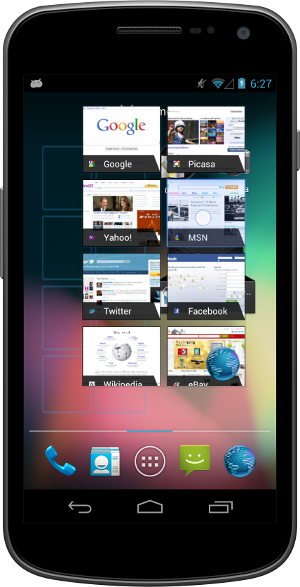
Android 4.1, Jelly Bean, is the quickest and easiest version of Android yet. Jelly Bean improves on the simplicity and beauty of Android 4.0, and presents a new Search experience on Android.
Everything in Jelly Bean feels fast, fluid, and sleek. Moving between homepages and changing between applications is simple and easy, like turning pages in a book.

Jelly Bean features improved performance throughout the program, including quicker direction changes, quicker reactions when changing between recent applications, and better and more consistent making across the program through vsync and multiple internet.

Jelly Bean has more sensitive and consistent contact reactions, and makes your device even more sensitive by enhancing your CPU immediately when you contact the screen, and turns it down when you don’t need it to improve battery.

What’s new in Jelly Bean

Accessibility 

Accessibility

  • With Jelly Bean, impaired customers can use ‘Gesture Mode’ to effectively get around the UI using touch and run activities along with conversation outcome.
  • With the new availability concentrate function, you can shift a pointer between controls to maintain a focus on for the next action or a source for the next routing event. You can dual tap anywhere to release the current product with availability concentrate.
  • Text traversal in availability now gives you more control – choose to shift between webpages, sentences, lines, terms or figures.
  • TalkBack, a screenreader for Android, now can handle activities to induce activities, to get around programs, and cross written text.
  • Get full support for braille availability services

Android Beam

  • With Android Beam, you can now easily share your pics and vids.
  • Instantly couple your phone or product to Bluetooth® gadgets like headphones or speakers that support the Simple Protected Coupling standard by just hitting them together.

Audio Accessories

  • Support for USB audio docks.

Browser 

Browser and WebView

  • Web browser has improved performance, CPU and memory performance. With better performance for animated graphics and HTML5 canvases and an modified JavaScript Engine (V8), pages load faster and feel better.
  • Browser now has better HTML5 video support, and has a new buyer. Just touch the movie to play and stop, and easily conversion into and out of fullscreen method.
  • Browser now can handle the modified HTML5 Media Catch requirements on feedback elements.
  • WebView now can handle straight written text, including Dark red Text and other straight written text glyphs.

Calendar 

Calendar

  • Calenderis more buttery. Material ends in, animated graphics are spread throughout, and swiping/paging between days is better.
  • Calendar will now show occasion shades if you’ve given your occasion a shade on your PC.
  • The ‘Today’ choice on the activity bar now reveals the present day. When watching an event’s information, you can now e-mail all the visitors with just one tap.
  • Notifications for future activities now show more of the occasion information to let you easily see appropriate information without having to start the app.
  • Notifications for future activities now let you e-mail all the visitors without starting the app, and you can pick a fast reaction such as “Be there in 10 minutes” or kind your own.
  • A new choice in Schedule configurations allows you make your own standard fast reactions for posting visitors.
  • You can now quick sleep an future occasion memory right from the alert.
  • Calendar has a new 7″ product structure that is enhanced for the kind aspect.
  • When watching Schedule in symbol direction on pills, you can cover up or increase manages to give you finish management over how you perspective your Schedule area.
  • Calendar will now keep in mind whether you’ve selected to cover up or increase manages so you have a regular encounter watching Schedule whenever you start it.

Camera and Gallery 

Camera and Gallery

  • You can swipe from the camera viewfinder to quickly evaluation images you’ve taken without having to leave the camera app. You can run return to the camera viewfinder to start taking images again.
  • When watching images in Collection, you can touch to zoom capability out to enter “filmstrip mode” and rapidly evaluation images. When watching images in filmstrip method, you can run up or down to remove an individual picture. You can also reverse the remove with a single tap.
  • When taking images, a new computer animated sweeps your picture off the screen. There is now a new paging computer animated when using between photos
  • Camera functions a new computer animated for changing between the front-facing and returning cameras.
  • When focusing on an item in Camera, a new computer animated gives you visual reviews on your focus state.
  • Gallery functions a new computer animated when selecting images from within the record view and returning.

Data Usage

  • You can now dismiss a data usage warning without changing the data threshold set for warning notifications.
  • Disable background data usage on certain Wi-Fi SSIDs by designating them as mobile hotspots.
  • Android now automatically detects when one Jelly Bean device is tethered to another’s WiFi hotspot, and intelligently enables or disables background data usage on the SSID.

 Face Unlock

  • Face Unlock is now quicker and much more exact, and start-up is smoother with a new animation.
  • You can improve face matching accuracy by calibrating your face in different conditions and with different accessories
  • Face Unlock can now optionally require a ‘blink’ to verify that a live person is unlocking the device rather than a photo.

Internationalization

  • Jelly Bean adds support for bidirectional text and more input languages to make the platform accessible to more people around the world.
  • There is improved support for Arabic and Hebrew, including a new Arabic font, in the platform.
  • You can now enter text in one of 18 new input languages, including Persian, Hindi and Thai. Additional Indic languages Kannada, Telugu, and Malayalam are now supported by the platform.
  • Emoji from Unicode 6.0 will now render when received or viewed.
  • If the system language is set to Japanese, Japanese specific versions of glyphs will now be properly rendered.

Keyboard

  • The platform’s dictionaries are now more accurate and more relevant.
  • The language model in Jelly Bean adapts over time, and the keyboard features bigram prediction and correction.
  • You can now switch languages quickly with the dedicated language selector key on keyboard.
  • You can use custom keyboard input styles for more than 20 languages, with keymaps for QWERTY, QWERTZ, AZERTY, Dvorak, Colemak, and PC styles.
  • You can choose the input styles that you want to use for each keyboard, and use a hotkey to switch between them while typing

Messaging and Talk 

Messaging and Talk

  • New notifications display the full text of incoming SMS messages. When receiving an MMS, you can view the full photo in a notification.
  • When entering recipients for an SMS or MMS, a new UI collects recipients as chips, making it easier to compose messages.
  • Talk features a new notification style.

Notifications

  • You can now take action on notifications directly from the redesigned notifications shade.
  • Notifications from the same application are grouped together, and the first item is automatically expanded. You can also pinch notifications to expand or collapse them.
  • You now get an image preview in notifications after taking a screenshot. You can quickly share the screenshot directly from the notification.
  • You can lock automatic display rotation from the notifications shade on 7″ tablets.
  • For Wi-Fi only devices, quickly see the SSID of the access point you’re connected to from the notifications shade.
  • You can now touch-hold a notification to identify the application that created it and turn off notifications from that application if needed, as well as uninstall the application.

Networking

  • Wi-Fi protected setup is now supported with WPS push button and PIN support.
  • A new setting lets you stay on mobile data and avoid nearby Wi-Fi networks with poor connections.

News 

News and Weather

  • News and Weather is updated to improve freshness and power consumption.

People 

People

  • The People app is more buttery with smoother animations and improved search performance.
  • The People app now retrieves high res photos automatically for Google contacts with public Google+ profiles and displays higher res photos (720×720) on certain devices.
  • High res photos set on Google accounts will be backed up and synced across devices.
  • The People app has a new 7″ tablet layout that is optimized for the form factor.
  • You can now quickly add your favorite contacts to a home screen, directly from the contact’s details page.
  • The People app helps you organize your contacts and reduces duplicates with an Improved auto-joining algorithm.
  • You can now clear the frequently contacted list from the favorites tab in the People app.

Phone 

Phone

  • When you miss a call, a new notification lets you return the call or reply by SMS with a single touch.
  • Incoming visual voicemails are displayed in a new notification that lets you play the message with a single touch.
  • When a call is ongoing, a new notification lets you hang up the call with one touch.
  • As part of Project Butter, the dial pad is more responsive. Call log scrolling is buttery smooth, and swiping between tabs in Phone is quick and fluid.
  • You can now clear your frequently contacted list in the favorite tab of Phone.
  • You can now add phone numbers from the call log to existing, read-only contacts.

Settings 

Settings

  • Accounts are now displayed in the primary Settings view so you can easily see all the accounts you’re signed into on your device.
  • You can now easily access all Google Privacy Settings in one place by selecting your Google account from Settings.

System 

System

  • Device encryption is now more reliable, and periodically reminds you to decrypt your device. Now, SMS messages and calls are declined when waiting for decryption.
  • You can long press the ‘Power Off’ option in the power menu to boot your device to safe mode.
  • A new ‘Reset app preferences’ button lets you quickly reset default applications for specific activities, background data restrictions, notifications suppressions, and more.
  • A redesigned dialog with larger icons lets you intuitively choose your preferred application for specific activities.
  • Google Apps Device Policy on your device may now override the ‘keep screen awake’ option from developer settings.

Text-to-speech

  • Jelly Bean introduces a new conversational text-to-speech voice in US English, available as both a network engine and an embedded engine via the TTS API.

Voice Typing

  • A new embedded speech recognizer lets you use Voice Typing even when you don’t have an Internet connection.

Widgets 

Widgets

  • Jelly Bean makes it easier to personalize your home screen. As you place widgets on the screen, everything else automatically moves to make room.
  • When they’re too big, widgets resize on their own. If you choose to resize a widget, apps and widgets will now also move out of the way.
  • You can now quickly remove apps or widgets from any home screen by picking them up and flinging them to the edge of the screen.
  • Launching apps and returning back home are now faster and smoother.

The new Google experience on Android

Google Search

  • With Jelly Bean, a redesigned experience uses the power of the Knowledge Graph to show you search results in a richer way. It’s easier to quickly get precise answers to search queries and explore and browse search results.
  • Get to Google Search faster: Google Search can be opened directly from the lock screen by swiping up. For devices with software navigation keys, you can now swipe up from the system bar to quickly access Google Search with Google Now. For devices with a hardware search key, you can tap it to launch Google Search.
  • If you’re using a wired headset, long press the headset’s button to activate Voice Search. You can quickly perform a search query by voice and have the result read back to you.
  • You can say “Google” to activate Voice Search from within Google Search.
  • For many search queries performed through Voice Search, you can now hear a spoken answer.
  • Voice Search recognition is now significantly faster so you can search quickly on the fly.
  • Voice Search can now recognize queries even when you have a poor network connection.

Google Now

Google Now brings you just the right information at just the right time. Cards appear throughout the day at the moment you need them, and appear as a notification when they’re important. Learn more.
  • Weather card: When you start your day, Google Now shows weather for your current location and work.
  • Traffic card: Get traffic conditions and alternate routes before you leave home or work.
  • Transit card: When you’re near a bus stop or a subway station, this card shows you what buses or trains are next.
  • Places card: When you’re on the go, Google Now will suggest nearby bars, restaurants, and places of interest.
  • Flight card: See flight delays and traffic conditions to the airport for flights you’ve recently searched for.
  • Sports card: You can see live scores and upcoming games and also buy game tickets on the fly.
  • Currency card: When you’re traveling, quickly check the local conversion rate.
  • Translation card: When you’re in a foreign country, you can quickly translate words into the local language.

Google Apps

Google+ 

Google+

  • As you swipe through the stream, large bold photos now fall into place with animations giving you a more interactive browsing experience.
  • Google+ on tablets has a new magazines layout in the stream.
  • You can now create and manage Google+ Events right from your device. Posts and photos are saved to the event so you can relive the party any time.
  • Party Mode lets you instantly upload and share photos during an Event so you capture all the right moments in one place.
  • New notifications let you +1, comment, or reshare without having to open the Google+ app.
  • You can now see live video streams of all participants in a Hangout.
  • A new navigation menu lets you easily navigate through the app and quickly see Google+ notifications.
  • When viewing a post, you can now swipe to expand and view comments.

Gmail 

Gmail

  • Gmail has an optimized view for 7″ tablets in portrait orientation to give you a better experience reading email.
  • Gmail and Email feature updated notifications will give you a preview and digest of your inbox. Notifications will also now display the full text of new mail.

YouTube 

YouTube

  • YouTube has a new, more intuitive user interface, including a guide that provides quick access to your channel subscriptions.
  • YouTube can now preload videos from subscribed channels for seamless playback even on slower networks.
  • With a new integrated menu, you can easily watch YouTube on the big screen with Nexus Q or YouTube TV.

Maps 

Maps

  • With support for offline maps, you can select an area to cache and access it even when you don’t have a data connection.
  • Compass Mode for indoor views and street view is more accurate and responsive with gyroscope support.
  • With Zagat ratings and reviews built in to Maps, you can quickly get the information you need about places you search for.
  • You can now browse Google Offers within Maps to find local deals.
  • Get indoor walking directions in Maps.

Currents 

Currents

  • With performance enhancements throughout the application and updates to the user interface, you can browse articles quickly and intuitively. With an enhanced layout engine for articles, you can enjoy dramatic, large images on a variety of articles.
  • Currents now uses hardware acceleration to make moving between articles smoother.
  • Currents has a new 7″ tablet layout that is optimized for the form factor.
  • For editions written in other languages, you can now translate text into your preferred language.

Google Play

  • A new set of recommendations widgets use a variety of signals — content that people with similar tastes have purchased, stuff that’s popular around where you live, content people in your Google+ circles have +1′ed, and more — to recommend new content like apps, games, music, and movies.
  • A new My Library widget, which displays all of your recent movies, books, music, and magazines and dynamically changes based on what you’ve been engaging with recently.
  • Smart App Updates ensure that only the parts of an application that have changed will be downloaded when you next update it, saving on time, bandwidth, and battery when updating apps.
  • Jelly Bean introduces app encryption for paid apps.

Play Books 

Google Play Books

  • Embedded audio tracks and videos can now be easily streamed directly within the book you’re reading.
  • You can now add bookmarks to remember important information for later or pick up where you left off reading.
  • Play Books now offers fixed layout books, optimized for tablet-reading of books with beautifully designed graphics and layouts, like children’s books and comic books.
  • For visually impaired users, automatic text-to-speech settings have been enabled.

Play Movies 

Google Play Movies and TV Shows

  • Movies and TV shows can be quickly downloaded for viewing offline, now with just one tap.
  • When you make a new purchase from Google Play, that item will be synced directly to the Play Movies and TV Shows app, ready for you to watch when you open the app.
  • You can watch Movies and TV Shows with Nexus Q by using the integrated media routing menu.
  • You can zoom in during video playback.

Play Music 

Google Play Music

  • A new Sound Search widget lets you identify songs you hear and purchase them directly from Google Play.
  • The Google Play Music widget now lets you thumbs up songs as their playing and features a new design for better readability.
  • Playlist art is automatically created based on the album art of songs in that playlist.
  • In the now playing bar, you can swipe between screens.
  • The Recent screen features larger album art.
  • You can delete tracks within the app.
  • There is a Now Playing queue of tracks.
  • There is an integrated media routing menu for listening to tracks on Nexus Q, Bluetooth audio devices and headsets.
  • You can set a song as your ringtone from Play Music, and the new ringtone editor lets you crop that track to the exact section you’d like to use for the ringtone.
Android Jelly Bean 4.1 [Change Log]

By: Unknown on: Monday, July 23, 2012
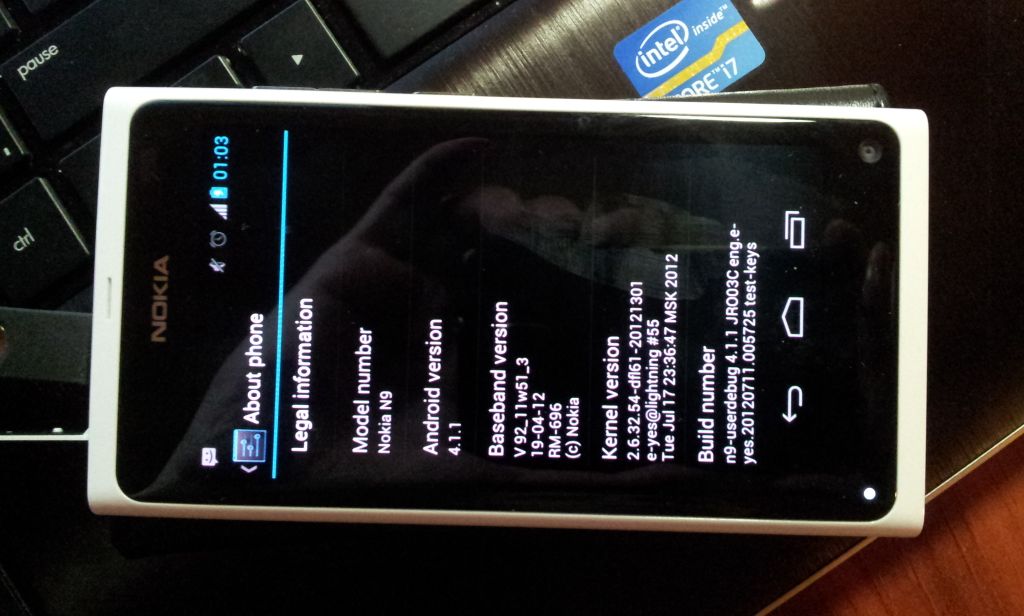
The latest version of Android – 4.1 Jelly Bean – has been ported, surprisingly enough, on the Nokia N9.

( Nokia N9 Running on Android 4.1 Jelly Bean: Click to enlarge )

Since the N9 is being slowly forgotten by Nokia, it is now up to the developers’ community to keep the thing alive. While official updates are still going on, we all know they won’t continue for long, so it’s good to see that N9 fans are taking matters into their own hands.The proof has been posted on Twitter by its developer.

Android 4.1 Jelly Bean ported on the Nokia N9

By: Unknown on: Monday, July 23, 2012

Jul 20, 2012


There has been much debate around exactly what improvements Samsung has brought to the table with the Galaxy S3 over the S2 and a big part of that discussion has concentrated on the two smartphones’ displays.

While many users have agreed that the S3’s screen is a natural evolution from the S2’s panel, there have been more than a fistful of critics disagreeing with that opinion, which has led to Samsung officials issuing statements defending the new display.

Naturally, that hasn’t completely calmed the criticism “storm”, but maybe DisplayMate’s most recent in-depth analysis will manage to do just that. According to what looks like a very objective report and comparison based simply on raw numbers, as well as extensive lab tests and measurements, the S3’s display is indeed an evolution from the S2’s panel, which itself is much better than the original Galaxy S screen in most areas.

The report is truly an in-depth one and might be a bit boring and overly “nerdy” for some of you, which is why we will try to very quickly summarize it and put it in a more mundane wording.

Galaxy S vs S2 vs S3 screens

By far the juiciest part of DisplayMate’s analysis is the comparison between the S, S2 and S3 displays. As expected, the Galaxy S3 comes on top quite clearly, but surprisingly (for many) the differences between Samsung’s latest flagship and the S2’s screen are not exactly “critical”.

It was a widely known fact that the S3 HD Super AMOLED screen comes with more pixels and sub-pixels per inch than the S2 Super AMOLED Plus panel, but when talking about brightness the new “beast” is actually not as competitive as the old one. In fact, the S3 comes with a poorer measured maximum brightness than even the original Galaxy S, so that’s not very good for Samsung. Then again, the screen reflectance helps make the S3’s brightness downsides not as visible in real use as you would think by looking at the raw numbers.


On the other hand, what makes the S3’s panel noticeably better and more competitive than its predecessors is the improved power efficiency, as well as the very smooth intensity scale and image contrast. In terms of power management especially, the new display performs significantly better, having a 5.6 hour running time at maximum display power (the S2 has only 4.4 hours).

As for the duel between the S2 and the S screens, this is pretty easily won by the former, mostly due to the higher brightness levels, color depth, reflection and contrast ratio.

OLED evolution in Samsung Galaxy S smartphones

While I’m sure that most of you will be interested primarily in the head-to-head battle between the S Series’ screens, DisplayMate’s report actually insists more on Samsung’s OLED evolution and in suggesting ways to drive the technology forward in the future.

If you’ll take a look at the report in full, you’ll notice that its author, Dr. Raymond Soneira, is mentioning more than just a couple of times that the technology “needs work”. Samsung’s “marketing policy” is especially criticized for crippling the OLED evolution, as most of S3’s issues come from the company’s desire to make the most competitive, brightest and power efficient display while keeping its thickness obscenely low.


Be that as it may, the report clearly states that Samsung has greatly evolved over the past years, having the potential to make OLED the future standard for smartphone screens. S3’s panel is better than the original Galaxy S display in practically every area, but there are a few of these areas that Dr. Soneira feels they haven’t been really pushed to their full potential.

There are many mentions of the OLED vs LCD battle in the report too, but as you might imagine there unfortunately isn’t a definitive conclusion to be drawn just yet.

Hoping that our little sum up (who didn’t turn out to be so little after all) didn’t bore you to tears already, we recommend all you “closeted” geeks out there to head over to DisplayMate and at least try to read the report in its fullness. There are truly very many interesting things to find out about Samsung’s OLED screens, the technology in general, and the comparison between OLED and LCD.

Have you met the S Family ?

By: Unknown on: Friday, July 20, 2012

Jul 19, 2012


The 64GB Samsung Galaxy S3 model has proven to be quite the elusive one out of the three announced versions, mostly because since its introduction, Samsung hasn’t quite yet gotten around to actually release the phone. This lead to speculations that the bigger capacity Galaxy S3 has been put on the chopping block. But has it really been cancelled?

The Verge has received an official statement from Samsung that should be enough to put the cancellation rumors to rest. While the phone is still coming, you’re going to have to hold on to your money that much longer, because, well, Samsung has only shared a rather vague release date.

Here’s what Samsung said:
The 64GB model of the GALAXY S III will be available during the second half of this year. The market availability and timing may vary and will be determined at the time of release.
We don’t think anyone is in any hurry to get the 64GB model seeing the storage flexibility that the Galaxy S3 has thanks to its microSD card slot. There’s a possibility that Samsung won’t be releasing it in the U.S. as well, since it was never formally announced for the country.

With that said — anyone waiting for the 64GB model of Samsung Galaxy S3?

Samsung Galaxy S3 - 64GB

By: Unknown on: Thursday, July 19, 2012

Jul 18, 2012


Remember the outlandishly awkward Galaxy Note that’s too big to be a phone, but too small to be a tablet? It appears that Samsung is cooking up a successor to the device which it will unveil at the end of August during the IFA 2012 consumer electronics show in Berlin. On top of this, it is rumored that the Galaxy Note II will come with a 5.5" display, which is slightly larger than the existing Galaxy Note’s 5.3" display. It will of course run Android 4.1 Jelly Bean, which is now the latest version of the operating system.


Under the hood, the device is believed to sport a more powerful quad-core processor – exactly which CPU still remains unknown – with the looming possibility of a camera megapixel bump to around 12 or 13 MP, a substantial boost from the existing 8MP camera on the device. But remember, image quality isn’t just in the megapixels; the actual lens and multiple other factors also play a pretty significant role in how well photos come out.

However, the device will not come with unbreakable plane display (UBP) technology, which is a precursor to the flexible display. Sources claim that the third iteration of the Galaxy Note is more likely to feature such technology.

As of June, the handful of a device had channel sales of over 7 million units. Definitely not bad, but it pales in comparison to the channel sales of the Galaxy S, and S II sales which have collectively topped 50 million worldwide (24 million Galaxy S units, and 28 million Galaxy S IIs have been sold globally). Some actual consumer sales figures would be nice, but I assume that the hype and demand surrounding the device isn’t anything too wild as of now.


It’s an awkward device. It requires two hands to use, it feels strange when it’s in your pocket, and you never know whether the device you’re using is a phone, tablet, or some sort of bizarre being that’s the result of a nuclear accident. However, despite this general opinion surrounding the device from the technology community, it seems to still be seeing a fair bit of sales. Samsung hopes to sell 10 million Galaxy Notes by the end of the year.

(via MKBusiness)

Galaxy Note 2 To Be Unveiled Soon

By: Unknown on: Wednesday, July 18, 2012

Jul 17, 2012


The smartphone sales war is definitely heating up. While Apple set the tone of the modern smartphone market when they released the iPhone – which was essentially the first “modern” smartphone – back in 2007, Google were quick to release Android, which would eventually overtake the iPhone in market share. 

Speaking of overtaking, should a Reuters poll prove to be accurate, it would appear that premier Android OEM Samsung may have overtaken Apple in smartphone sales in Q2 of this year.

According to the poll, Samsung is expected to have sold a total of 50 million smartphones in Q2, which is roughly 20 million more than what Apple was observed selling in the same quarter (30.5 million). IDC analyst Francisco Jeronimo concurs, and also thinks that Samsung will come out on top in the second quarter. He points out that such high sales are largely driven by the Galaxy lineup of devices, namely the Galaxy S II and the newly released Galaxy S III.


It would be interesting to find out how big a role the Galaxy S III played in these sales. With heavy worldwide advertising, it surely played a substantial role here. Apple isn’t the only company that Samsung has outsold, though. To refresh everyone’s memory, the company sold 3.4 million more phones than Nokia in the first quarter of this year, which to be quite honest isn’t surprising considering how people are more inclined towards iOS, and even Android. They essentially toppled Nokia’s 14-year sales reign in the smartphone market. In the second quarter, Samsung is estimated to have sold a whopping 15.7 million more phones than Nokia, which in turn is a huge number in our books.


Something else that Reuters’ poll noted was the increasing importance of ZTE and Huawei; lower-end mobile device manufacturers that create cheaper phones, targeted towards emerging markets. Given the rise of people seeking lower-priced smartphone devices in such regions, this isn’t too surprising.

What remains to be seen is whether Samsung will maintain its reign. While it’s safe to assume that Nokia won’t be gaining a lead on Samsung anytime soon, perhaps in the latter quarters of this year, Apple may go neck and neck or even overtake it once the next-generation iPhone is announced and released.

Samsung: One, Apple: Zero

By: Unknown on: Tuesday, July 17, 2012

Jul 13, 2012

Apple and Google follow very different principles with their mobile platforms. Apple maintains a tightly closed system where they put their software on their own hardware whereas Google has a much more open policy. Google licenses Android to companies like Samsung, HTC and Motorola which manufacture their own hardware and run it on customized versions of Android.

While Apple’s way has plenty of advantages there is one area where it lags behind Google: sheer units sold and total market share.

Android smartphones as a whole have been dominating the iPhone in USA for quite some time now. In a latest report, its dominance has been reaffirmed. Check out the details after the jump.


The report comes from data* released by market analysis firm Kantar Worldpanel Comtech. The data shows that Android is the number one smartphone operating system in countries like the USA, France, Spain, United Kingdom, Italy and Australia.

In Spain, a whopping 84.1% of smartphones sold were running Android. The lowest sales were in Italy which still saw 49.6% sales. In every other country mentioned above, Android smartphone sales were above 50% of total smartphone sales.

In the US where we last reported Android being the top mobile operating system, well, the dominance continues. However, Kantar notes that despite having just above 50% smartphone market share, Android’s share has decreased by 6.8% last year. Apple’s current share is 37.4% which has increased by 8.7% over 2011.

Kantar claims that most of these sales come from people ditching their feature phones (almostsmartphones) in smartphones which have become very cheap now. Android phones in particular come with modest prices and better technical specifications and features than offerings running other operating systems. To back this up, Kantar cites the sales of the low-end Samsung Galaxy Ace and Galaxy Y which are “selling well”.


So yes, Android does have major market share in major countries due to so many different Android phones being sold but let’s not forget that Apple gets to maintain majority of the profits** with just three iPhones: 3GS, 4 and 4S.


(via CNET)

*According to the report, the data was recorded over a period of twelve weeks that end on June 10th.

**Data released by Gartner and Oppenheimer & Co. from 2011: Android grabbed majority smartphone market share while Apple grabbed 65% of entire mobile industry’s profits.

Android Domination

By: Unknown on: Friday, July 13, 2012

Jul 12, 2012

Always eager to add little treats for their intrepid user-base, Google appears to have added an Easter egg to Android 4.1 Jelly Bean that goes beyond the norm.

Fans of Android smartphones and tablets will no doubt already be aware that Google’s engineers like to add a little something for them to find when playing around with their new toys. The most famous amongst these Easter eggs is something that is found inside the Settings app of Android smartphones.

Take the latest version, Jelly Bean, for example. Heading into the Settings app, and then navigation to the section which lists the Android software version number will display the expected number of 4.1. From here, repeatedly tapping that number will treat onlookers to a magical tour in which plenty of jelly beans are paraded for our viewing pleasure. Neat, right?


While this same Easter egg has been around in previous versions of Android, it seems Jelly Bean takes things one step further. Tapping again will add a collection of candy canes to proceedings, something which doesn’t really fit with the current Android Jelly Bean branding. So, what does it mean?

The first and most obvious suggestion is that this is a hint towards what the next version of Android will be called. The problem here is that Google is known for naming its software versions by choosing a dessert that begins with the next letter in the alphabet. So, with the first version of Android being called Cupcake, the next was Donut, with Éclair following that. Next was Froyo, with Gingerbread and Ice Cream Sandwich paving the way for Android 4.1, Jelly Bean. Assuming Google intends to follow the same naming convention, Candy Cane really doesn’t work unless someone at the company decides that Candy is really spelled ‘Kandy’ which, to be honest, wouldn’t surprise us one bit.


One school of thought is that Google is planning a Christmas announcement because candy canes are usually a Christmas affair. We’re not convinced, but with Google being the way it is, we doubt those candy canes are there for no reason. They’re telling us something, but we just don’t quite know what it is.

Yet.

So, what do you guys make of it? You know where to drop your thoughts.

(via SlashGear)

What's after Jelly Bean ?

By: Unknown on: Thursday, July 12, 2012

Jul 11, 2012


If you’ve seen one of Samsung’s ads over the last year or so then you’ll probably already know that the Korean firm has not been too shy about poking fun at Apple. In fact, Samsung has even seen Apple’s customers as fair game when putting its ads together, making fun of the people who line up outside an Apple store for a new iPhone, for example.


With the Galaxy S III’s arrival in the United States, and perhaps with one eye on the ongoing legal battles between the two, Samsung has decided to move away from the Apple bashing it is so fond of, instead deciding to promote its new phone based on its features rather than the fact it isn’t an iPhone.


Three new ads are now airing for the Galaxy S III in the United States, with all three being variations on a similar theme. Samsung has decided to push the new phone’s ability to share files with other people easily, removing the need for dongles, cables and any other random wire that may be needed with other smartphones.

The first ad shows a group of people asking a passer-by to take a photo of them. The ad continues as each member of the group asks for the same photo to be taken on their own phone so that they have a copy. The ad finishes with a Galaxy S III owner taking a photo and then wirelessly sharing it with their Galaxy S III owning friends. No iPhone in sight.

The remaining two ads follow a similar trend, with a baby being born in one and the photos being shared across a range of Galaxy S III devices instead of just one handset being passed around a group of people. It’s a real-world example that may not crop up too often, but you get the idea.

Samsung has been criticized in the past for its making Apple a target in its ads, especially stooping to the level of aiming jibes at iPhone users. The new ads are much more conventional, with the device in question being shown off rather than a competitor being made fun of.

It helps that the Galaxy S III is an awesome phone, too!


The new Galaxy S3 is all about poking fun at Apple

By: Unknown on: Wednesday, July 11, 2012

Jul 10, 2012

Google’s I/O conference brought little in the way of surprise, but still presented aficionados of the Big G with plenty to get excited about. As well as the Nexus 7 tablet, which has seen an uprising in talk of a smaller iPad (a device which, as yet, hasn’t been proved to be in development), Google also announced Android Jelly Bean (4.1), the successor to the rather tasty Ice Cream Sandwich (4.0) operating system.

As a result of the conference, many developers have suffered from the so-called "itchy finger," desperate to get their paws on the new OS, and as somebody who likes to dabble with any mobile OS, I’m pleased to reveal that the day has finally arrived.


Jean-Baptiste Queru, the Technical Lead of the Android Open Source Project, has revealed the news that Android 4.1 has been released in AOSP today, under the name "android-4.1.1_r1." For the sake of clarification, the name of the development branch is jb-dev, and anybody looking to sink their teeth into the release is advised to create new clients. Even if you’re working in the master branch, your clients will be a great deal smaller and faster to sync if you create new ones.


At the time of writing, proprietary binaries are available only for the recently barred Galaxy Nexus and the newly-announced Nexus 7 tablet, although the popular Nexus S and Xoom devices will soon join the party.

The release of the source code will certainly unlock new possibilities, although it’s up to the developers to decide exactly what these possibilities may be. The Android community, above any other mobile ecosystem, benefits greatly from its community, with many developers willing to put in additional time in order to enhance the experience for themselves and others. Anybody affiliated with Android (be it a developer or an end-user) should be stoked about this news, and I’ll be keeping a close eye on the Google Groups in order to catch any further developments.


Ice Cream Sandwich may have dragged its heels in making an impression on the Android community, but it appears Google won’t be making the same mistakes again with Jelly Bean

Android 4.1 Jelly Bean Source Code Released

By: Unknown on: Tuesday, July 10, 2012

Jul 8, 2012


It is official folks, CyanogenMod 10 aka CM10 will be coming soon for all supported Android devices in the near future, based on the latest version on Android – Android 4.1 aka Jelly Bean. According to the CM team, any device that met the criteria (512 MB of RAM) for CM9 based on Ice Cream Sandwich should be getting CM10 as well (Which includes the Samsung Galaxy S2 which Samsung said it won't be getting the update), helped by the fact that JB is not that major an upgrade compared to what ICS was from Gingerbread.

From what the CM team has been able analyse so far without the actual sources for Jelly Bean, the new changes and features in Jelly Bean should be incorporated pretty quickly in the CM10 build, with refactoring expected to be needed for the Trebuchet launcher, lockscreen enhancements and the inbuilt Theme Engine. The full analysis will only be available once the source code for Jelly Bean is released, but it looks like CM10 will arrive much quicker than CM9, which was given a full rewrite from the ground up and hence took a lot of time. After a final stable release of CM9, the CM team will shift focus to developing only CM7 (for devices capable of only CM7) and CM10.

The manufacturers and carriers are sure to take their sweet time to push out Jelly Bean to their devices, but thanks to CM10, most users will probably not have to wait for the official Android 4.1 updates. Here’s to CM10 making its way to devices quickly and as soon as possible!

Android 4.1 Jelly Bean coming to SGS2 in the near future [UPDATED]

By: Unknown on: Sunday, July 08, 2012

Jul 6, 2012

If it’s not the new iPad, it’s rife rumor regarding the upcoming next-gen iPhone that’s keeping Apple in the news just now. The device, which is thought to be receiving a longer screen, will also be getting a mighty quad-core processor, if a report originating from DigiTimes is to be taken as Gospel.

The blogosphere has become used to taking DigiTimes coverage with a pinch of salt – primarily because many of the big leaks stem from unspecified sources, and this latest report doesn’t break the habit of a lifetime.

The iPhone is credited with changing the face of the modern-day smartphone, but after sticking with the same ethos throughout in terms of screen size and general power (i.e. good quality, but not eye-watering), it appears the fruit company is now playing catch-up with rivals.


A quad-core processor would be quite a bump from the current dual-core A5 chip offered with the iPhone 4S, and would also boast more power than the third gen iPad which, despite offering quad-core graphics, is still only a dual-core A5X processor.

DigiTimes being DigiTimes, I can’t say I believe this one, especially since my current iPhone 4S has been running for months, with numerous games and apps, yet without so much as a second of lag. I’m more inclined to believe Tim Cook’s company will opt for the A5X once again, which would still be fast, and allow for smooth gaming on the slightly larger screen

Of course, I could be wrong, and given Apple’s apparent push towards the larger screen, a quad-core processor wouldn’t be a massive shock. Still, although the company appears to have gone with the flow in increasing the display real-estate, a new chip exceeding the A5X would seem like too much of a leap, while also not being particularly necessary.

As with most Apple products, we’ll likely only know in the days leading up to the announcement what the next iPhone – dubbed the "iPhone 5" – will include. Although LTE would seem a foregone conclusion given the iPad implementation, the only other aspect we could presume without doubt to be a feature, is iOS 6, which was announced last month at WWDC 12.


Of course, I will be keeping you updated with anything I pick up in the meanwhile, though, so stay tuned!

Apple following the steps of Samsung (iPhone5)

By: Unknown on: Friday, July 06, 2012

Jul 5, 2012

Home automation technology is here, but hardly anyone uses it. Sure, there are plenty of home automation products, and serious enthusiasts. But the average home remains conspicuously manual. 

To your average Silicon Valley engineer, the reason is obvious: lack of standards. 

The problem is that different home automation products use different, incompatible and often proprietary technologies to make their magic happen. If you buy two products from two companies, they usually won’t work together. Standards groups like Z-Wave and Zigbee Alliance have attempted to create industrywide standards but have been ineffective so far. 

The computer technology companies are now rushing into this vacuum of standards to provide them. Leading the charge is none other than Microsoft. Best known as the maker of the Windows operating system for personal computers, Microsoft views the entire home as a “computer” and is creating an operating system for it. 

Microsoft’s HomeOS, as it's called, is designed to bring law and order to the lawless frontier that is home automation. Perhaps best of all, there are indications that Microsoft's HomeOS will support existing standards, so even home automation products already purchased may work with HomeOS. 


How does HomeOS work? 

Most of us don’t have to think about what makes a computer system succeed, but Microsoft does. 

Computers have an operating system, which is software that orchestrates interaction between the hardware and the application software. For example, you are reading this with a web browser or in a mobile app, both of which are application software programs. This software doesn’t actually put these words on your screen. It sends requests to the operating system, which conjures up all the elements required to display text and photographs on a screen. 

In fact, many of the things that application software appears to do are in fact done by the operating system. 

That’s one of the biggest benefits of Microsoft’s HomeOS. Many of the jobs that home-automation appliances might want to do can be done by HomeOS. Instead of every appliance maker and software maker reinventing the wheel, they can simply make requests of the HomeOS and have the job done for them. 

That means a small company can create an appliance much more easily and reliably. Let’s say, for example, that a company wants to make and sell a lamp that dims when the TV is on. Instead of having to create the technology to know when the TV is on, the lamp maker can simply use the published instructions for HomeOS for being informed by the system when the TV is on. 

A standardized platform promotes the automation of homes by making it easier for companies to make home automation products. 

The idea is that Microsoft will try to convince home-automation companies to create both hardware and software that supports HomeOS. Consumers will buy these products, which are likely to include all the things one might automate: sprinklers, lights, home-entertainment systems, fans, doorbells, heaters, air conditioners, coffee makers, dishwashers, robotic vacuum cleaners and home security systems. 

In addition to products that support HomeOS, you would buy a server, which would be a small computer system that everything would connect to, mostly wirelessly. You would control your home automation with a smart phone. This actually improves the experience, because as this image shows, you can see camera feeds on your phone, which is probably always going to be with you. 

And finally, the coolest thing of all: a HomeOS app store. 


The HomeOS app store 

So you’ve got your HomeOS server, and you’ve got some devices that support HomeOS. Now what? Microsoft is planning to offer a HomeOS app store, where you can browse and download software that will automate your home. 

This makes sense coming from the world's largest software company. This screen capture shows a control panel, where you can check the status of all smart devices in the house. This wasn't created by Microsoft, but by a supporting partner for another platform that Microsoft makes. A "control panel" category of apps is just one that will exist in the HomeOS app store. 

For example, some company might offer an app that puts the video feed from your security system up on the TV when it detects motion. Another company might offer software that sends you a text message when someone comes to your door. Another might develop software that plays music based on who’s in the room (by detecting your cell phone). 

Nobody knows what applications will be available on the HomeOS app store. And that’s the point. Hundreds or thousands of software makers can offer more variety than any one company alone. 

As one example of a very friendly application, Microsoft researchers are developing something called HomeMaestro. 


The HomeMaestro idea 

A Microsoft research project called HomeMaestro is working on making it easier to control devices in your home. 

The approach uses regular language, rather than complex controls. The idea is an old-fashioned if-then statement common to basic software programming: If something happens, then make something else happen. 

In a video demonstration, HomeOS researchers use the simple example of: “If I open the door, then turn on the light.” This command is called a rule, and it’s controlled on your smart phone. 

The HomeMaestro project does a neat trick. As you build these rules, you use the action to inform the app. For example, you tell the app to create a rule. Then you open the door manually. “The door opens” appears in the top box. 

Then you click on the Then box, and turn on the lamp. “Turn on the lamp” appears in the Then box. You save your rule, and automation has been set. In the future, when you open the door, the lamp will turn on. 

The HomeMaestro project would have all home automation work this way — by example. 

While the door-and-lamp example is very simple, the rules for home automation could be very complex: If I watch a show, don’t record it. If the air temperature outside is below 50 degrees between the hours of 6 a.m. and 8 a.m., turn on and warm up the car when I make coffee. When everyone is in bed, turn off all the downstairs lights and appliances. 

The possibilities are endless. Especially since the HomeMaestro project envisions social sharing of rules — a "rules store" where you can browse and download rules created by others for your own use. 

So when is HomeOS coming home? 

Microsoft has been developing HomeOS for years and has been testing HomeOS in real homes. It's called on students and Microsoft programmers to create apps for the HomeOS app store. 

So far, Microsoft has not announced a product release date, pricing or other details, so that means we won’t see products on the market this year. However, with other competitors also preparing similar offerings, including search engine giant Google, I would be surprised if next year didn't see a big launch of the new Microsoft HomeOS product, and a tsunami of home appliances that support it.

For more information about this click here

Home Automation Technology Is Here !

By: Unknown on: Thursday, July 05, 2012

Jul 4, 2012


Canada’s long-time technology standard bearer, RIM -aka BlackBerry- , is fighting for survival amidst dismal sales and waning consumer interest. With the release of BlackBerry 10 and the accompanying new hardware now pushed back to early 2013 — a full year later than it was originally promised — things don’t look good. 

With an uneasy board feeling the ever-increasing heat (surely at Robot Devil levels now) from investors, RIM is now feeling the pressure to consider all possible options to right the ship. On that list: getting into bed with Microsoft. 

The relationship could take a number of forms, of course. There’s no doubt that Microsoft would love to acquire a good chunk of RIM’s patent portfolio. Doing so would further protect Windows Phone and give Microsoft additional ammunition in its ongoing licensing “skirmishes” with Android OEMs. Another option would be a Nokia-style collaboration. RIM’s board is reportedly not too keen on giving up the amount of control they’d be required to if Microsoft were to buy a stake in the company and kick in for R&D and marketing expenses. 

And don’t forget about Windows Phone 8. RIM could stop developing their own mobile OS, thereby allowing more time and effort to be devoted to higher-margin enterprise products and services. 

Would that really be a good idea, though? With an uncertain future and no new OS for at least six months, it’s hard to imagine that competing against HTC and Samsung with Windows Phone 8 would really be any harder than competing with them using an OS that most of the western world has already lost interest in.

BlackBerry going out of business

By: Unknown on: Wednesday, July 04, 2012

Jul 3, 2012


Technology creates tremendous opportunities to improve people’s lives. But to make the most of them, we need to focus—or we end up doing too much and not having the impact we strive for. So last fall we started a spring clean, and since then we’ve closed or combined more than 30 products. Today we’re announcing a few more closures. Here’s a summary of the changes we’ll be making:

  • The Google Mini has been an important part of our Enterprise Search offering since it was first introduced in 2005. It’s had a good run, but beginning July 31 we’re discontinuing the product because its functionality can be better provided by products like Google Search Appliance, Google Site Search and Google Commerce Search. We will of course continue to provide technical support to Mini customers for the duration of their contracts, and will reach out to them shortly with more details.
  • Google Talk Chatback allowed websites to embed a Google Talk widget so that they could engage with their visitors. It’s now outdated, so we’re turning off Chatback and encouraging websites to use the Meebo bar.
  • Google Video stopped taking uploads in May 2009. Later this summer we’ll be moving the remaining hosted content to YouTube. Google Video users have until August 20 to migrate, delete or download their content. We’ll then move all remaining Google Video content to YouTube as private videos that users can access in the YouTube video manager. For more details, please see our post on the YouTube blog.
  • On November 1, 2013, iGoogle will be retired. We originally launched iGoogle in 2005 before anyone could fully imagine the ways that today's web and mobile apps would put personalized, real-time information at your fingertips. With modern apps that run on platforms like Chrome and Android, the need for iGoogle has eroded over time, so we’ll be winding it down. Users will have 16 months to adjust or export their data.
  • We’ll soon be retiring our Symbian Search App to focus our efforts on our mobile web search experience. We encourage you to go to www.google.com and make it your homepage or bookmark it. Switching from the app to the web experience will enable users to make the most of the web-wide improvements we make for search all the time. 

Closing products always involves tough choices, but we do think very hard about each decision and its implications for our users. Streamlining our services enables us to focus on creating beautiful technology that will improve people’s lives.

Google is cleaning the house!

By: Unknown on: Tuesday, July 03, 2012

Jul 1, 2012

( Update > Android Jelly Bean 4.1 [Full Review]  )

Android 4.1 Jelly Bean will be available in a few weeks. Besides the brand new Nexus 7 tablet, the first devices to receive the latest Android update from Google will be the Galaxy Nexus, Nexus S, and the XOOM. Following Google’s mind boggling Keynote announcement at Google I/O, the Android team posted the platform highlights, recapping all of Jelly Bean’s new features. Here are a few I am particularly excited about.

Faster, Smoother, More Responsive

Due to the success of Google’s “Project Butter”, the latest version of Android is just like the saying goes “as smooth as butter”. Jelly Bean is the most responsive and impressive version of Android to date coming with triple buffered graphics, extended vsync timing and intuitive touch that boosts your CPU at the next touch event to make sure lag is minimal.

Enhanced Accessibility

Jelly Bean includes new API’s for accessibility features such as services that let you handle gestures and manage accessibility focus with on-screen navigation buttons. These can be handled by accessibility gestures, accessories, or other input methods. Applications that use the standard View components inherit support for these new features automatically without the need for developers to alter their code.

Support For International Users

Android 4.1 helps developers reach more users through support for bi-directional text. Apps can handle text editing in left to right or right to left scripts. Apps can also make sure of new included Arabic and Hebrew locales and fonts. If that isn’t enough, the platform now supports user-installable key-maps.

Expandable Notifications

Android 4.1 brings a major update to Android notifications. Apps can now display larger, richer notifications to users that can be expanded and collapsed with a pinch. Notifications support new types of content, including photos, have configurable priority, and can even include multiple actions assigned to them.

Resizeable App Widgets

Android 4.1 introduces improved App Widget functionality that can automatically resize, based on where the user drops them on the home screen, depending on the size, and the amount home screen real estate available. You can also supply separate landscape and portrait layouts for your widgets, which the system activates depending on your current screen rotation
.
High Resolution Contact Photos

With Android 4.1, we cab finally store our contact photos at a whopping 720 x 720, allowing contact pictures to be truly beautiful. Apps can store and retrieve contact photos at that size or use any other size as needed.

Android Beam

Android Beam was introduced with ICS, but we haven’t seen a lot of uses for it. In Android 4.1, Android Beam makes it easier to share images, videos, or other payloads by leveraging Bluetooth for the data transfer. When the user triggers a transfer, Android Beam hands over from NFC to Bluetooth, making it easier to transfer and manage files between devices.

Smart App Updates

The latest feature of Google Play introduces a better way to receive application updates on your devices. When a developer publishes an app update, Google Play now only delivers the changes bits of the application rather then the entire APK.  This makes app updates much lighter and easier on your network data. On average, a smart app update is about 1/3 the size of the full APK update.

Google Voice Search and Google Now

Google has drastically improved the default Voice Search functionality with Android 4.1. Dubbed Google Now, the new search functionality makes search much more visual such as displaying your results as cards for weather, navigation routes, sports scores, and more. This is much more than a virtual assistant.


These are only a few of the features that come with Jelly Bean. For a full feature listing including subscriptions, I suggest you check out the full Jelly Bean feature list to see what’s all under the hood. Just because this is a “dot” release doesn’t mean it isn’t major. This is more than just API enhancements. This is a major update.

Android 4.1 Jelly Bean Highlights [UPDATED]

By: Unknown on: Sunday, July 01, 2012


It seems this is the end of the road for Flash on mobile devices. Adobe tried their best to bring Flash to the mobile world, to both Android and iOS, but we all know what Steve Jobs thought about Flash, so that was never going to become a reality. Flash, even today, has poor performance on mobile devices, unless you own at least a dual core smartphone. With the world moving on to h.264/HTML5 video, there is less and less reason for Adobe to continue to pour resources into developing Flash for mobile/Android.

Both Adobe and Google have said last year that Android 4.0 is the last version to support Flash, and Google also said Chrome wasn’t going to support it when they launched the beta version earlier this year. Adobe is announcing again that they won’t support Android 4.1 going forward, in either browser, so don’t think you’ll be able to use it in Firefox or something.

If you want to continue to use Flash, you’ll have to use only an Android 4.0 or earlier device that comes with Flash pre-installed, or alternatively, you’ll have to install it by August 15th, because that’s when Adobe will also pull the Flash app from the Play Store, and you won’t be able to get it from the store from that date forward. Hopefully now that Flash is gone from the mobile world forever, we’ll see sites adopt HTML5 video at an accelerated rate, because otherwise their viewers won’t be able to view videos on mobiles.

Flash is going away from the mobile world forever

By: Unknown on: Sunday, July 01, 2012


While the Galaxy S3 has been confirmed to get the Jelly Bean Update, I don't like to deliver Bad News for Galaxy S II users, but I have to forward the info I got. According to the latest Reports I received, The Samsung Galaxy S II I9100/I9100G won't be getting the Android 4.1 Jelly Bean Update which has been announced on the Google I/O 2012.

The Galaxy S II won't taste the latest Android 4.1 Jelly Bean due to Hardware limitations,Taking in account the following reasons :
  • Low screen resolution 800 x 480 - 1280 x 720p recommended resolution.
  • Dual-core Processor - Quad-core recommended.
  • Device won't be Smooth with Jelly Bean and TocuhWiz running together.
These reasons may prevent Samsung from Updating the Galaxy S II to Jelly Bean, the same thing happened with the Galaxy S I9000 when samsung announced it won't be able to Update the device to ICS 4.0.3 because of hardware limitations and the users won't be able to run ICS smoothly on their devices.

Galaxy S 3 Confirmed

As for me... i'll be waiting for XDA to deliver us the unofficial Jelly Bean update just like what they did with the ICS for the Samsung Galaxy S one.

SGS2 won't be getting Jelly Bean 4.1 [Hardware limitations] (UPDATED)

By: Unknown on: Sunday, July 01, 2012

 
Copyright © @AndroidBasha's Blog